
I have long followed social psychologist Jonathan Haidt because he has been one of the few public voices willing to defend childhood. I treasure its preservation as a mother of five.
Haidt is behind the movement to get cell phones out of schools, and his bestselling book The Anxious Generation is a battle cry to reclaim childhood by attempting to turn the clock back to the days when children were free of screens and social media. He reminds us that children once had “more independence, free play, and responsibility in the real world.” A failure to protect childhood will shape the health of our society for generations, and not for the better. Yet few are willing to treat it like the crisis it is.
I share Haidt’s belief that childhood should be protected for as long as possible. Like him, I also felt it was just as important to teach them good character, accountability, perseverance, and grit. I believe it is harder to do in wealthy societies, where comfort and convenience so often replace the formative pressures of adversity and responsibility.
A new report from Sapien Labs’ Global Mind Health Project 2025 seems to prove this thesis. With ~2.5 million respondents across 85 countries, it “tracks trends in ‘mind health’ and wellbeing in the Internet-enabled world” and has measured these trends since 2019. It describes “mind health” as the capacity to navigate life’s challenges and function productively in the world. The study identifies “four key drivers of declining mind health in young adults”:
- Deteriorating family bonds.
- Declining spirituality.
- Increased use of Smartphones in childhood and,
- Ultra-processed food consumption.
The assessment referenced in the Global Mind Project is self-reporting and yields what the authors call a “Mind Health Quotient” (MHQ). It aggregates self-ratings across cognitive, emotional, social, and physical problems. One of the overarching, and frankly unsurprising conclusions from the report is that as nations get richer and more technologically capable, young people become less resilient, less capable, and often suffer from poor mental health. The report describes it as the “paradox of progress.”
The report also shows that young adults are faring dramatically worse than their elders. It finds that “the mind health of adults ages 55+ has remained consistently at scores of ~100,” a normal score. However, in contrast, However, almost half of those under 35 “suffer mental health challenges of clinical significance that substantially impact their ability to function productively in daily life, over four-fold higher than their parents and grandparents.”
The Data
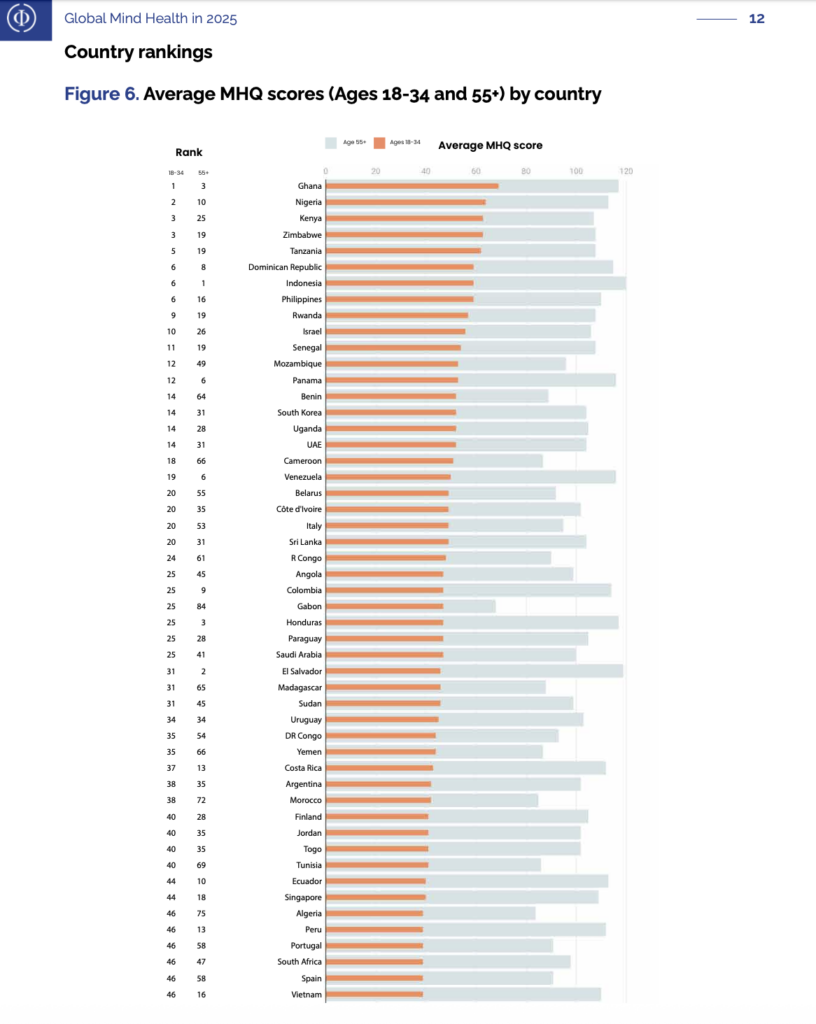
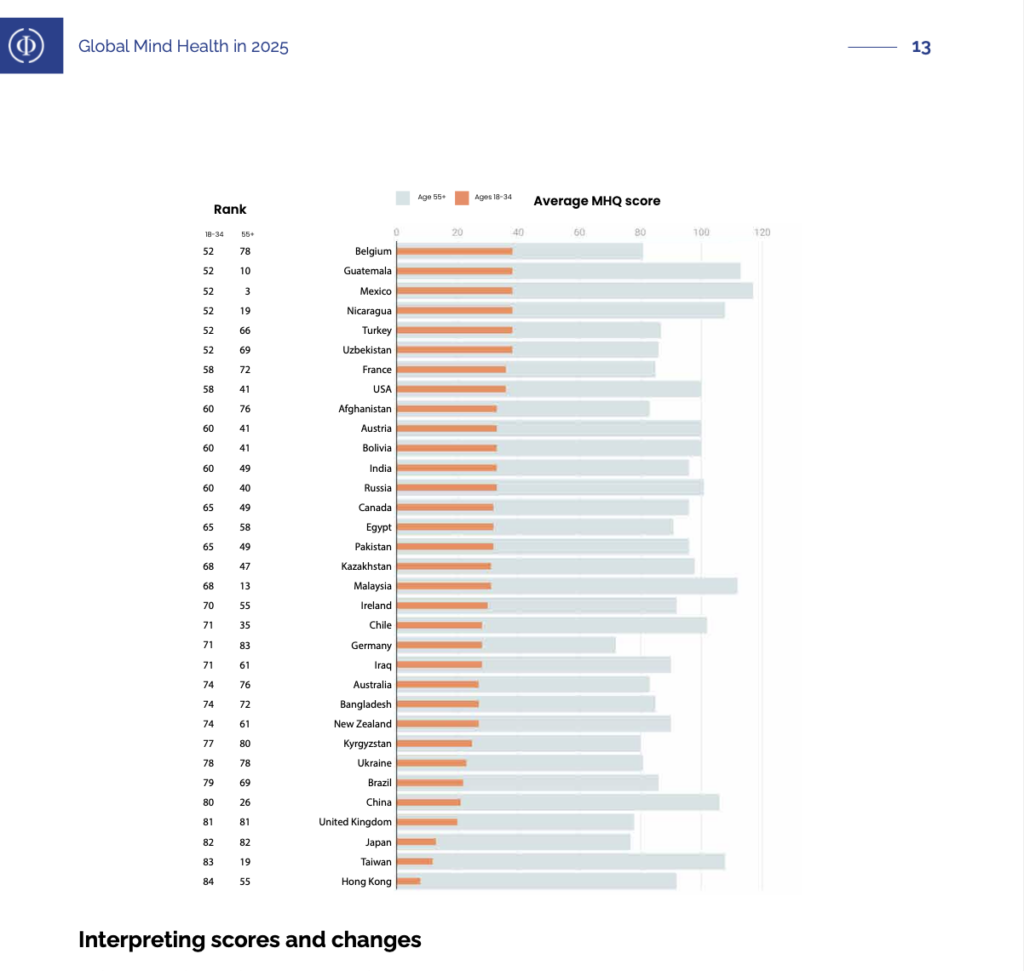
In general, the 18-34 age group fares worse in all countries. However, a look at regional data shows young adults fare best in Sub-Saharan Africa and worse in wealthier countries, noting the top performers for ages 18-34 are in Sub-Saharan Africa. The lowest-ranked 10 countries include the UK, New Zealand, Japan, Taiwan, Hong Kong, and China.
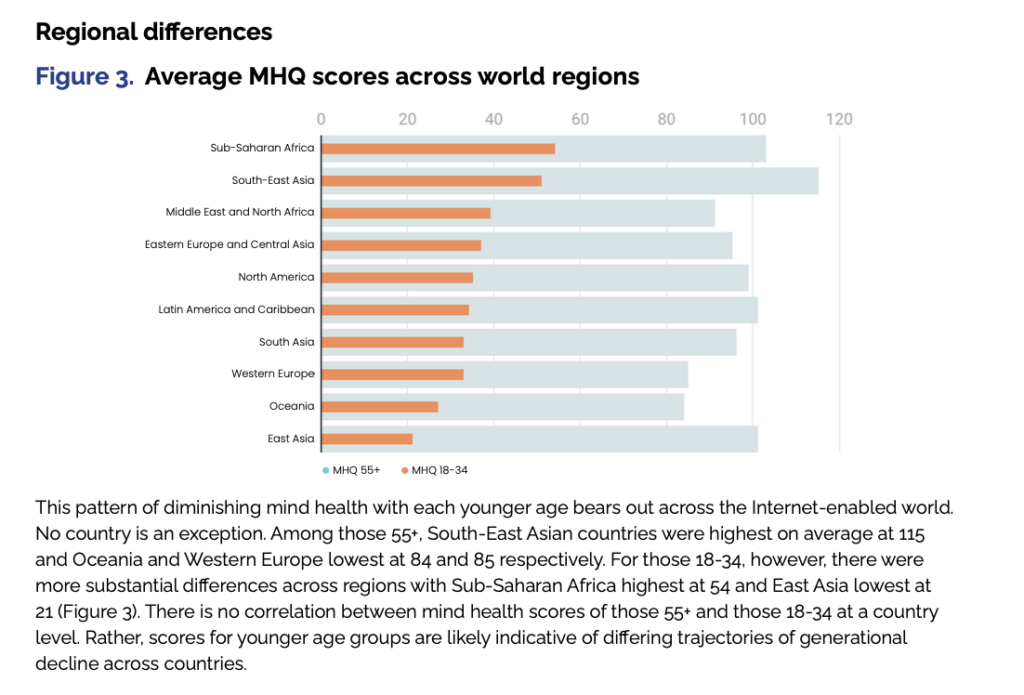
Broken down by country, the 18-34 age group tends to have better average MHQ scores in lower-income countries. In the U.S., the 18-34 age group in 2025 ranks 58th, with an average score of below 40, and the 55+ age group ranks 41st, with a normal average score of 100. Notably, there is no country in which the average score is normal for the 18-34 age group.
Gen Z was the first to grow up fully in the smartphone era. Ranked by the age a child was given a smartphone, Finland is at the top having given phones to children on average at the age of 10. Tanzania and Uganda gave smartphones to children on average at the age of 18. The study concludes that the younger the age of first smartphone ownership, the more likely that child will suffer from “suicidal thoughts, aggression, and other problems in adulthood.”
The report challenges the common assumption that improved “monetary wealth and technological capacity” make life better for young people. It is an important assumption to challenge because it “underpins policy frameworks around the world where economic growth and technological advancement are treated as the primary indicators of societal progress.”
Reclaiming Childhood
Frankly, this report should surprise no one. Common sense alone will tell you that family bonds, connection to God or something outside oneself, participation in real life, not virtual reality, and good eating habits are critical to good “mind health.”
So, what does it mean to reclaim childhood? Our children spanned three decades, when the internet and technology went from desktop to smartphone and everything in between. We went from analog to digital over a period of 35 years.
The pressure to introduce that world to our children was relentless. However, while other families had cellphones and gaming systems, we resisted. Instead, our kids played until twilight and rode their bikes to school in the snow. We ate dinner together and talked about their daily triumphs and struggles. They had regular chores and were required to mend their own conflicts.
As they grew, we bought one computer and shared it. Even when our fifth child arrived and the older children had cellphones, I never tracked our teenagers with GPS. Instead, they had to check in and if they didn’t show up on time, there was a conversation to reset expectations and discuss why they failed to follow house rules.
When parents rely on GPS to track their children, it robs them of the chance to learn accountability. It sends the message that they cannot be trusted to be directly responsible for their actions. Trust is the glue of healthy relationships and the only way to strengthen trust in relationships is to test trustworthiness and allow the child to then understand what happens when he doesn’t take it seriously.
Small children need real-world relationships. Beyond the parental bond, the playground becomes the teacher. Bumps, bruises, games and cliques, these are the child’s first encounters with the hard knocks of life. If parents hover, always fix things, or step in when the child is perfectly capable of handling it, they rob him of the ability to trust himself and to find the grit to fail, recover, and try again.
Resilience is forged in childhood and childhood is foundational. Parenting that models good character and cultivates grit is relentlessly challenging. There are no shortcuts, and no amount of money buys back the time you didn’t invest in your relationship with your child. Good parenting reveres the minutiae of everyday life. Children need clear boundaries, consistency, and steady mentoring in what good character looks like. Good manners, integrity, and self-control make the child more acceptable to the world beyond the family, an inevitable rite of passage every human must face.
When children are exposed to the world mainly through smartphones and the internet, it doesn’t just erode innocence, it weakens their ability handle life’s vicissitudes. And that’s before we consider what screens do to attention spans, self-confidence, reasoning, and problem-solving. Every hour spent looking at a screen is an hour not spent gardening, riding a bike, building, playing with friends, or visiting a grandparent. Screen time has a way of melting time and time is the one thing we can never get back.
There simply is no substitute for the real world, real relationships, or meeting adversity with perseverance and grit. So yes, it is no surprise that increased wealth and advanced technology are disabling our children and their developing brains in ways we have yet to fully comprehend.
FreedomForever.us partners with a number of organizations such as Bark and Protect Young Eyes to protect and prepare families for an online world. Parental involvement is imperative for children of all ages. Please consider prohibiting or limiting the use of social media and limiting time spent online on all devices, including Smartphones. Your child will thank you.
Freedom Forever is an all-volunteer organization that focuses its energy and time on preserving the innocence and safety of children.
*Please subscribe here for the Freedom Forever newsfeed.
*This article was originally published in American Thinker.